


Resources
Why Your Business Isn’t Showing Up in Google’s AI Answers (And How to Fix It)

Try something right now. Open Google and type the question your best customer would ask before hiring you. Not your service name — the actual question, like “who can fix my website near me?” or “how long does a logo redesign take?”
Read the AI summary at the top. Is your business in it?
For most small businesses, it isn’t. The answer names a competitor, a directory, or a forum thread from three years ago. You get nothing, even if you rank fine in the regular results underneath.
That’s the problem AI search optimization is meant to solve: making your business easy for AI tools to find, understand and trust enough to mention. It’s newer than regular SEO, but it leans on a lot of the same groundwork. Where people get stuck is knowing what’s actually broken on their own site. This post covers why businesses get skipped, how to check whether you’re one of them, and what to fix first — including the local side, which most guides on this topic skip entirely.
What AI Search Optimization Actually Means
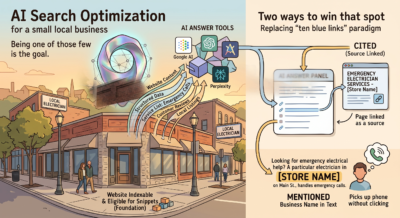
AI search optimization is the work of shaping your website and online presence so that AI answer tools — Google’s AI Overviews and AI Mode, ChatGPT, Perplexity — can find your business, understand what you do, and include you in their answers.
These tools don’t hand back ten blue links. They read a batch of sources, build one answer, and name or link only a few of them. Being one of those few is the goal.
There are two ways to win that spot. You can be cited, meaning your page is linked as a source. Or you can be mentioned, meaning your business name shows up in the answer text with no link attached. For a local business, a mention can matter just as much as a citation — someone reads that a particular electrician in their town handles emergency calls, and they pick up the phone without ever clicking through.
Here’s the reassuring part: Google has said its AI features build on the same foundations as normal search — your page still needs to be indexed and eligible to appear with a snippet. There’s no separate switch that turns AI visibility on. So most of the fix is ordinary technical and content work, not something exotic.
Step One of AI Search Optimization: Find Out If You’re Really Missing
Most articles jump straight to tips. Don’t skip this part, or you’ll never know whether anything you change actually worked.
It takes about an hour:
- Write down 10 questions a customer would ask before hiring you, in their own words. “Do I need someone to maintain my WordPress site?” beats “website maintenance services.“
- Run each one in Google (use a private browser window), in Google’s AI Mode, in ChatGPT and in Perplexity.
- Log the results in a spreadsheet. Were you mentioned? Were you linked? Who showed up instead of you?
- Repeat the same test a week later. AI answers shift between runs, so one pass proves nothing on its own.
Then read the pattern, not just the results. If you show up in normal Google results but never in AI answers, the problem is usually your content or your trust signals. If you don’t show up anywhere, start with the technical side first. And take note of who does get named consistently — those are your real AI competitors, and they’re often not the businesses you’d assume.
AI Search Optimization Starts With a Site That Can Be Read
If an AI tool can’t reach or read your page, nothing else on this list will matter. Check for these first:
- A leftover noindex tag. Developers add these while a site is being built, and they sometimes stay live after launch, quietly hiding pages from every search tool.
- A robots.txt file blocking crawlers. Some sites block AI crawlers on purpose. Some do it by accident. Check what yours actually says.
- Content that loads late. If your main text only appears after heavy JavaScript runs, some crawlers see a nearly empty page. Right-click, view page source, and search for a sentence from your page — if it’s not there, that’s your answer.
- A slow, glitchy site. Timeouts, plugin conflicts and server errors all make crawlers give up before they finish reading.
- Old, unattended pages. Outdated content, spam left behind after a hack, broken redirects. Each one drags down trust across the whole domain.
Google Search Console will show you which pages are indexed and which aren’t, so start there before guessing.
Most of these problems trace back to one root cause: a site nobody is actively maintaining. Plugins that haven’t been updated, speed that hasn’t been checked, security that hasn’t been scanned in months — that’s exactly what ongoing website maintenance is for, and it’s far cheaper to keep up with than to discover, months later, that pages have quietly dropped out of the index.
Write for the Question, Not Just the Keyword
This is where a lot of AI search optimization efforts fall apart. AI tools lift specific passages, not entire pages. If the answer to a question is buried under three paragraphs of warm-up, it never gets picked up.
Compare two openings under the heading “How often should a WordPress site be updated?”
Weak: “In today’s fast-moving digital world, keeping your site current is more important than ever.”
Strong: “WordPress core and plugins should be updated at least monthly, with security patches applied as soon as they’re released. Sites that take payments or store customer data should be checked weekly.”
The second version can be lifted and quoted word for word. The first says nothing an AI tool — or a human — can actually use.
A few habits help here:
- Put the direct answer in the first sentence or two under every question-style heading.
- Be specific. Name the towns you serve, how long a job takes, what’s included and what isn’t. “Quality solutions tailored to your needs” gives an AI tool nothing to repeat.
- Phrase headings the way people actually ask things out loud.
- Add a short FAQ section to your main service pages, built from real questions customers ask on sales calls.
The Gap Most Guides Skip: Local Signals in AI Search Optimization
Almost every article on this topic is written for software companies and national brands. Advice like “build topical authority” or “get cited by major publications” doesn’t do much for a plumber in a town of 15,000.
Local businesses get surfaced through different signals. When someone asks an AI tool for “a good electrician near me” or “best coffee shop in Yorkton,” the answer leans heavily on Google Business Profile data, reviews, map listings and directories — often more than on your actual website. If those are messy or inconsistent, you can be invisible even with a strong site behind them.
Check these four things:
Your name, address and phone number match everywhere. Google Business Profile, Yelp, Facebook, your chamber of commerce listing, your website footer. Two different addresses across directories is more common than you’d think, and it leaves machines unsure which one to trust.
Your Google Business Profile is fully filled in. Correct categories, complete services list, defined service areas, current hours, fresh photos and regular posts.
Your reviews say something specific. “Great service!” doesn’t tell an AI tool anything. “They fixed our website after it got hacked and had us back online the same day” does. You can’t script what customers write, and you should never buy or fake reviews — but when you ask for one, you can ask a specific question: what did we help with, and what town are you in?
Your service area is clearly stated on your site. One solid page explaining where you work and what you do there beats forty town names crammed into a footer.
There’s an added advantage for smaller markets: in rural areas, there’s often very little online about local businesses, which means AI tools have thin material to draw from. A business that clearly states who it is, where it works and what it does can end up as the only usable source in the room. That’s a real edge, and most local competitors aren’t using it yet.
Get Talked About Elsewhere: The Off-Site Side of AI Search Optimization
AI tools don’t only trust what you say about yourself — they weigh what others say too. A business mentioned on a chamber of commerce page, a supplier’s dealer list, a local news story and an industry directory reads as more established than one that exists only on its own website.
You don’t need a large PR push to move this. Aim for five solid mentions this quarter:
- Your local chamber of commerce or board of trade
- A supplier or manufacturer that lists dealers or clients
- A local sponsorship or community event page
- An industry association directory
- A quote or short feature in a local or trade publication
Use the same business name and the same one-line description every time you’re listed. Skip paid link schemes entirely — they carry real risk and don’t build the kind of trust an AI tool is actually looking for.
Show Who’s Behind the Business
AI tools also look for signs that a real, accountable business stands behind a page. A proper About page with real names and photos, your location, how long you’ve operated, and any credentials or memberships all help. Put a named author on your blog articles. Make your contact details easy to find, not buried three clicks deep.
Structured data — LocalBusiness and FAQ schema — helps machines read your details cleanly, and it’s worth adding. But be realistic about what it does: schema makes you easier to parse, not more deserving of a mention. Use it on top of solid content, never as a substitute for it.
A 30-Day AI Search Optimization Plan
- Week 1: Run the 10-question test. Check Search Console for indexing gaps, noindex tags and blocked crawlers.
- Week 2: Clean up your Google Business Profile and fix any name, address or phone mismatches across directories.
- Week 3: Rewrite your top three service pages with answer-first openings and specific details. Add an FAQ to each.
- Week 4: Ask two or three customers for specific reviews, earn one or two new local mentions, then rerun the test and compare.
Repeat this every month or two. Don’t expect a sudden jump — progress usually looks like one new mention here, one new citation there.
What Not to Waste Time On
A few things get more attention than they’re worth right now.
- Anyone guaranteeing a spot in AI answers. Nobody controls what these tools say. Treat that promise as a red flag.
- Special AI files like llms.txt. They get talked about often, but Google has said it doesn’t use them for its search features. Don’t spend a weekend on this before your basics are fixed.
- Rewriting your whole site at once. Pages that read clearly to people usually read clearly to machines. Start with the pages that matter most.
- Chasing every AI tool at once. Pick the two your customers actually use and focus there.
Frequently Asked Questions About AI Search Optimization
What is AI search optimization?
It’s the practice of making your website and online presence easy for AI answer tools — Google’s AI Overviews, ChatGPT, Perplexity — to find, understand and mention in their answers.
Is AI search optimization different from regular SEO?
They overlap heavily. Indexing, site speed, quality content and trust signals matter for both. The difference is emphasis: AI tools favour direct, specific answers and clear signals about who you are, which matters even more for local businesses.
How long does it take to show up in AI answers?
There’s no fixed timeline. Technical fixes can show results within weeks once pages are recrawled. Reviews, directory clean-up and local mentions usually take a few months to move the needle.
Do I need special schema markup?
Nothing is required. LocalBusiness and FAQ schema help machines read your details, but they support good content — they don’t replace it.
Can a small local business show up in AI answers?
Yes. In smaller and rural markets, a business with a complete Google Business Profile, consistent directory listings and clear service pages often has less competition for those answers than people assume.
Start With the Test
You don’t need a new website or a big budget to move on AI search optimization. You need to know where you actually stand. Run the 10-question test this week, write down what you find, and fix the biggest gap first. For most businesses, that gap is a neglected site or a messy Google Business Profile — and both are very fixable.