


Resources
How to Rank Your Google Business Profile in the Top 3 (Local Pack Guide)

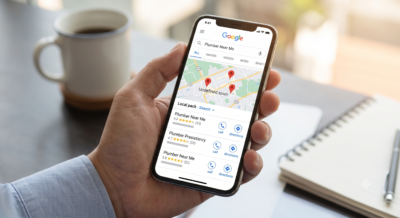
Search for “plumber near me” or “marketing agency in Yorkton” and the first thing you see isn’t a website. It’s a map with three businesses underneath it. That block is the local pack, and the businesses inside it collect the majority of calls, direction requests, and website clicks from local searches.
If your Google Business Profile isn’t one of those three, you’re essentially invisible to the customers who are ready to buy right now. The good news? Most businesses competing for those spots are doing the bare minimum. They claimed their profile, added a phone number, and stopped. That means the top 3 is more winnable than you think — especially in smaller Canadian markets, which we’ll get into shortly.
This guide walks through what actually moves the needle, in the order it matters.
How Google Decides Which Profiles Make the Top 3
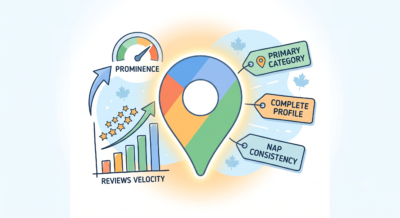
Google ranks local results on three factors: relevance, distance, and prominence. Relevance is how well your Google Business Profile matches what someone typed. Distance is how close you are to the searcher. Prominence is how established and trusted your business looks across the web.
Here’s what most guides won’t tell you: you can’t change your distance, but you can absolutely widen the radius you compete in. A profile with strong relevance and prominence signals will outrank a closer competitor with a neglected listing. We see it constantly. The rest of this guide is about stacking those signals so distance becomes the factor that matters least.
Start With Your Primary Category — It’s the Heaviest Lever
Your primary category is the single most influential field on your entire Google Business Profile. Get it wrong and nothing else you do will fully compensate.
Choose the category that describes what you are, not everything you do. A bakery that also does catering should be “Bakery” first, with “Caterer” as a secondary category. Then add up to nine additional categories that cover your real services. Don’t stuff irrelevant ones in — Google cross-checks categories against your reviews, website, and services list, and mismatches dilute your relevance.
Revisit your categories twice a year. Google adds new ones regularly, and a more precise category than the one you picked in 2022 may now exist.
Complete Every Field, Then Keep the Profile Alive
A complete profile outperforms a partial one, full stop. Fill in your hours (including holiday hours), services with descriptions, products, attributes, opening date, and a business description that mentions your city and main services naturally.
But completeness is table stakes. What separates top 3 profiles from page-two profiles is activity. Google treats a Google Business Profile like a social channel: profiles that post updates, answer questions, add photos, and respond to reviews signal an operating business worth showing. A profile that hasn’t changed in eight months signals the opposite.
A realistic cadence that works:
- One post per week (an offer, a project, a tip — anything genuinely useful)
- Three to five new photos per month, taken by you, not stock
- Review responses within 48 hours, every time
That’s maybe an hour a week. Most of your competitors won’t do it, which is exactly why it works.
Reviews: Velocity Beats Volume
Everyone knows reviews matter. What’s less understood is how they matter.
Google weighs review velocity — the steady arrival of fresh reviews — more heavily than your lifetime total. A business with 40 reviews earning three new ones every month will typically outrank a business with 90 reviews whose last one landed in 2024. Old reviews decay in ranking value; a consistent trickle tells Google your business is actively serving customers today.
Practical ways to build velocity without begging:
- Ask at the moment of peak satisfaction — right when a project wraps or a problem gets solved, not two weeks later by email
- Make it one tap: use your profile’s short review link in follow-up texts and invoices
- Respond to every review, positive or negative. Responses are content Google reads, and they encourage the next customer to leave one
One more thing: reviews that naturally mention your service and city (“best website design in Yorkton“) reinforce relevance. Never script this for customers — but do ask them to mention what you helped with.
The Small-Town Advantage Nobody Writes About
Most local SEO advice is written for Toronto, Vancouver, or American metro areas, where dozens of businesses fight over a five-kilometre radius. If you operate in a smaller city or rural region, the game is different — and mostly in your favour.
In low-density markets, Google stretches the local pack’s radius dramatically. There simply aren’t enough nearby options, so a well-optimized Google Business Profile in a town of 15,000 can appear for searches happening 50 or even 100 kilometres away. That’s an enormous catchment area you can win with a fraction of the effort a city business needs.
Three things to do if this is you:
Set your service area deliberately. If you travel to customers, list the actual towns and regions you serve rather than leaving the default. This tells Google exactly which distant searches you’re a candidate for.
Name your region on your website. Your profile links to your site, and Google reads that site for context. Pages that mention the communities you serve — naturally, in real sentences — extend your reach across the whole area.
Out-activity the neighbours. In small markets, your competitors’ profiles are usually dormant. A modest, consistent effort — weekly posts, fresh photos, prompt review responses — often makes you the only active profile in the region. Google notices.
Fix Your NAP Before It Quietly Sinks You
NAP means Name, Address, Phone number. Google checks whether these details match everywhere your business appears online — directories, social profiles, chamber listings, Yelp, industry sites.
Conflicting information erodes trust. If your address reads “123 Main St” on your profile, “123 Main Street, Unit B” on one directory, and an old address on another, Google can’t be certain which is right, and your prominence takes the hit. This is one of the most common problems we find when auditing profiles that are stuck on page two, and it’s entirely fixable: search your business name, list every citation, and correct the mismatches one by one. Tedious, yes. Optional, no.
Your Website Still Carries Half the Weight
Your Google Business Profile doesn’t rank in isolation. Google connects it to the website it links to and reads that site to confirm what you do and where you do it.
A thin, outdated, or slow website caps your local pack potential no matter how polished your profile is. At minimum, the page your profile links to should load fast on mobile, name your city and services in real content (not hidden text), and include the same NAP details as your profile. If your site hasn’t been touched in a few years, that’s often the missing piece — our small business website design and maintenance work exists for exactly this reason.
Adding LocalBusiness schema markup to your site is worth the small effort too. It hands Google your business details in a structured format, removing any ambiguity about who you are and where you operate.
Why This Matters More as Search Gets AI-Driven
Google’s search results increasingly include AI-generated answers that recommend specific local businesses by name. Those recommendations pull heavily from Google Business Profile data: categories, reviews, photos, Q&A, and business descriptions.
In other words, the same work that gets you into the top 3 also gets you cited when someone asks Google’s AI “who’s the best marketing agency near me.” Businesses with sparse profiles don’t just miss the local pack anymore — they miss the answer entirely. The profiles winning today are the ones treating this as an ongoing channel, not a set-and-forget listing.
Where to Start This Week
If you do nothing else, do these four things in order: verify your primary category is the most precise one available, fix every NAP inconsistency you can find, ask your three happiest recent customers for a review, and publish one post on your profile. Then repeat the last two weekly.
Ranking a Google Business Profile in the top 3 isn’t a trick — it’s consistency applied where your competitors aren’t applying any. If you’d rather have someone handle the audit, cleanup, and ongoing optimization for you, Growth Media Strategy helps businesses across Saskatchewan and beyond turn their profiles into their best source of leads. Get in touch and we’ll show you exactly where your profile stands today.
Frequently Asked Questions
How long does it take to rank a Google Business Profile in the top 3?
Most businesses see movement within 60 to 90 days of consistent optimization — faster in smaller markets with weaker competition, slower in dense urban areas. Category fixes and NAP cleanup often produce the earliest gains.
Can I rank in the local pack without a website?
You can appear, but you’re competing with one hand tied. Google reads your linked website to confirm relevance, and profiles connected to strong, locally relevant sites consistently outrank those without one.
Do Google Business Profile posts really affect rankings?
Posts contribute to the activity and engagement signals Google uses to gauge whether a business is operating and relevant. Their individual effect is modest, but combined with photos, review responses, and Q&A activity, regular posting is part of what separates top 3 profiles from dormant ones.
Why does my competitor rank above me with fewer reviews?
Likely some combination of a more precise primary category, better review velocity (newer reviews, even if fewer), cleaner NAP citations, and a stronger linked website. Total review count is only one signal among many.
Does serving a rural area hurt my local rankings?
No — it often helps. In low-density regions, Google widens the local pack radius because there are fewer nearby options, so an optimized profile can capture searches from a much larger area than it ever could in a major city.