


Resources
Google Ads vs SEO: Which Should a Small Business in Saskatchewan Invest In First?

A rancher supplier in Yorkton and a dentist in Regina can ask the same question: should I pay Google for clicks, or spend on SEO? The honest answer is different for each of them, and most advice online skips over why.
Google Ads vs SEO isn’t a contest with one winner. It’s a question of timing, market size and cash flow. For most small Saskatchewan businesses, the best order is simple. Fix your Google Business Profile and website first, run a small and tightly targeted Google Ads budget for fast leads, and build SEO as the long-term engine. Here is how we get there, and when the order flips.
Google Ads vs SEO: The Short Answer
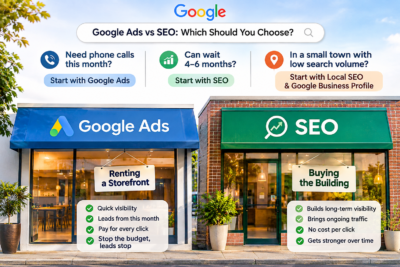
If you need phone calls this month, start with Google Ads. If you can wait four to six months and want leads that keep coming without paying for every click, start with SEO. If you’re in a small town where few people search for what you sell, start with local SEO and your Google Business Profile, because that’s where the cheapest visibility is.
Most owners we talk to fall into the third group without realizing it.
How Google Ads and SEO Actually Work
Google Ads is pay-per-click advertising. You bid on search terms, your ad appears at the top marked “Sponsored,” and you pay each time someone clicks. Turn the budget off and the leads stop the same day.
SEO earns your place instead of buying it. You improve your website, your Google listing and your reputation until Google trusts you enough to show you in the map results and the regular listings. It’s slower, but organic traffic doesn’t charge per click, and the work builds on itself.
Think of Google Ads as renting a storefront on the main street and SEO as buying the building. Renting gets you open tomorrow. Buying costs more up front in time and effort, and it’s yours after that.
Why Google Ads vs SEO Looks Different in Rural Saskatchewan
Most comparisons of SEO vs PPC are written for big cities. They assume thousands of people search for your service every month. In Saskatchewan, that often isn’t true, and it changes the math.
Search volume is thin. In a town of a few thousand people, “plumber near me” might get a few dozen searches a month. An ad campaign built for that audience can run for weeks without enough clicks to learn from. You end up paying for data instead of customers.
Google stretches the map. When few businesses compete in an area, Google widens the local pack, the three-business map result, to cover more ground. A well-built Google Business Profile can show up for searches in towns 50 kilometres away. That’s a real advantage for rural businesses, and a big-city competitor can’t copy it. Our guide on how to rank your Google Business Profile in the local pack covers the steps.
Your competitors are small too. Innovation, Science and Economic Development Canada reports that the overwhelming majority of Canadian employer businesses are small businesses. In practice, that means the business ranking above you is probably one owner with a half-finished website. That’s good news. You don’t need a massive budget to pass them.
Customers travel, and they search by voice. People in rural areas drive further for what they need, and many ask their phones. Searches like “find a welder near me” or “where can I get tires in Yorkton” are growing, and they reward businesses with accurate, complete listings. We wrote about this in voice search optimization for local businesses.
Your year has seasons. Farm suppliers, outfitters, tourism operators and landscapers can’t wait six months for SEO to kick in before their busy season starts. Timing matters more than most guides admit.
When Google Ads Should Come First
Paid search makes the most sense in these situations:
- You have a deadline. A new location, a seasonal rush or a slow quarter that needs filling.
- You sell a high-value service. If one new customer pays for a month of ads, the maths works quickly.
- You’re testing an offer. Ads give you answers in weeks about which wording and services people actually respond to.
- Your website is already solid. Ads send traffic to your site, so a slow or confusing page wastes the money.
That last point trips up a lot of businesses. If your site loads slowly or breaks on phones, fix that before spending a dollar on clicks. A properly maintained website makes every ad dollar work harder. And if you’re not sure what a good site involves, our breakdown of website costs in Canada will help you plan.
When SEO Should Come First
Put SEO first when:
- Your customers research before they buy. Think accountants, contractors, wedding vendors and anyone selling something people compare.
- Click costs in your industry are high. If every click costs a lot, organic traffic saves you real money over time.
- You want to be found in AI answers too. Tools like Google’s AI Overviews and chatbots pull from sites that are clear, trustworthy and well-structured. The same work that helps you rank also helps you get cited. We cover this in why your business isn’t showing up in Google’s AI answers.
- You’re building for the long haul. A business you plan to run for ten years benefits from assets that keep paying.
Local SEO in Saskatchewan also tends to be cheaper than people expect, because the competition for local terms is light. A few months of steady work on your listing, your service pages and your reviews can change your visibility completely.
The Google Ads vs SEO Order We Recommend
After working with dozens of Saskatchewan businesses, here is the sequence we use most often.
Step 1: Get the basics right. Claim and complete your Google Business Profile, make sure your name, address and phone number match everywhere online, and check that your website loads fast on a phone. This costs little and helps both channels.
Step 2: Run a small, focused ad campaign. Pick your one or two best-paying services and target only the areas you actually serve. Keep the budget modest. The goal is early leads and learning which search terms bring real enquiries.
Step 3: Build SEO alongside it. Write service pages for each thing you offer, collect reviews steadily and publish useful content that answers your customers’ real questions.
Step 4: Shift the balance as organic traffic grows. When SEO starts delivering leads, you can reduce ad spend on the terms you now rank for and use it elsewhere.
This isn’t the only route. A business with a tight deadline might go heavier on ads for months. A business with no urgency might skip ads entirely. The point is to choose on purpose.
Common Mistakes in the Google Ads vs SEO Decision
Treating it as either/or. The two work better together. Ads show you which keywords convert, and SEO makes those wins permanent.
Expecting SEO results in a few weeks. Anyone who tells you otherwise is guessing. Also, no one can guarantee a number one ranking, and a promise like that is a red flag. In Canada, the Competition Bureau enforces rules against false or misleading advertising claims, and that applies to marketing services too.
Setting up ads without tracking. If you can’t tell which clicks became calls or quotes, you can’t tell if the money is working. Set up call tracking and conversion tracking from day one.
Ignoring your Google Business Profile. For local businesses, it’s often the single highest-return piece of the puzzle, and it costs nothing but attention.
Four Questions to Decide Your Google Ads vs SEO Priority
- How soon do I need leads? Within weeks points to ads. Within months points to SEO.
- How many people search for what I sell locally? Very few points to local SEO first.
- What is one new customer worth? The higher the value, the easier ads are to justify.
- Is my website ready? If not, fix it before spending on either channel.
If your answers split between the two, that’s normal, and it’s the reason most good strategies use both.
Frequently Asked Questions
Is Google Ads or SEO better for a small business?
Neither is better in every case. Google Ads is better for fast results, and SEO is better for lasting, lower-cost traffic. Most small businesses do best starting with a solid Google Business Profile, then adding a small ad budget while SEO builds.
How long does SEO take to work in Saskatchewan?
Typically three to six months to see steady movement, sometimes faster in smaller markets with less competition. Results depend on your starting point, your industry and how consistently the work is done.
Can I stop Google Ads once my SEO improves?
Often partially. Once you rank well organically for a term, you can reduce ad spend on it. Many businesses keep ads running on high-value or seasonal terms.
Do small towns even have enough searches for Google Ads?
Sometimes not. If a campaign gets very few impressions, widen your service area or focus on local SEO and your Google Business Profile instead.
Will SEO help me show up in AI search results?
It helps. Clear, accurate, well-structured content from a trusted site is what AI tools tend to reference, and that’s what good SEO produces.
The Bottom Line
Google Ads vs SEO is really a question of what your business needs right now. Ads buy you speed. SEO builds something that lasts. In rural Saskatchewan, where competition is light and Google rewards local relevance, SEO often delivers more than owners expect, and a small ad budget fills the gap while it grows.
If you’d like help working out the right mix for your business, Growth Media Strategy, a digital marketing agency in Yorkton, Saskatchewan, offers local SEO, Google Ads management and Google Business Profile support for small and rural businesses. Get in touch for an honest recommendation, even if the answer is to start smaller than you thought.